
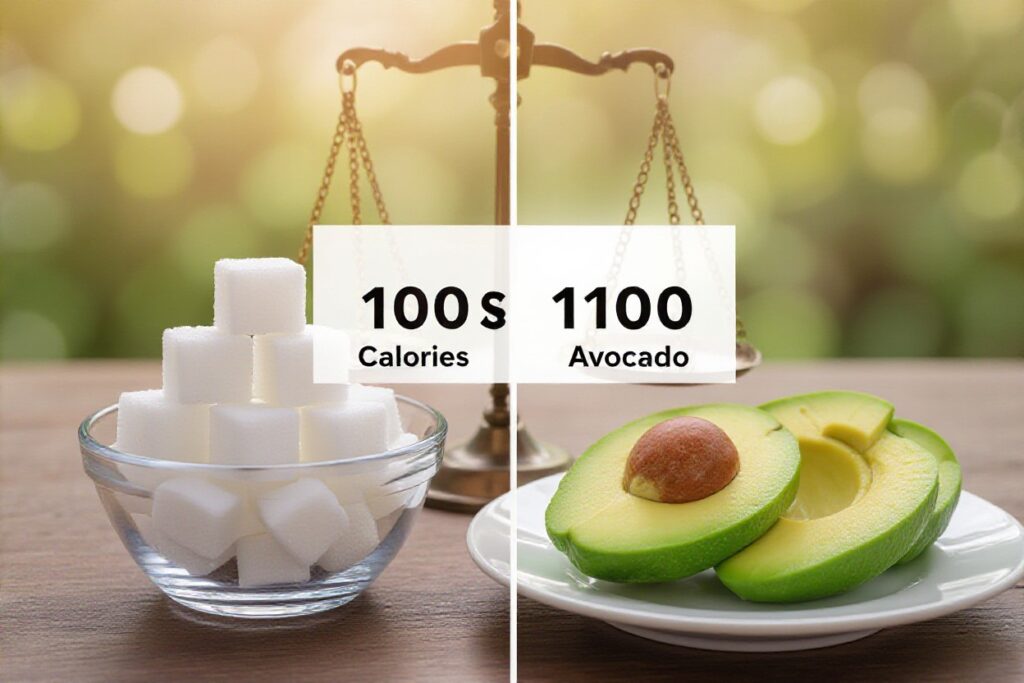
Metabolism talk has been popping off on social media lately, and you’ve probably seen creators casually saying “a calorie is just a calorie” while pouring zero-calorie soda over their meal prep… but that’s where your body completely disagrees. When you eat 100 calories of soda versus 100 calories of avocado, you’re sending totally different hormonal signals, flipping very different metabolic switches, and either feeding inflammation or supporting real fat-burning and repair.
The scary part is that you can hit your calorie target, yet still drive fat storage, cravings, and chronic disease if most of your intake is sugary junk. On the flip side, loading up on quality fats and whole foods can keep you satisfied, energized, and actually able to lose fat without feeling like you’re at war with your own appetite.
Key Takeaways:
- Ever wondered why you can crush a can of soda and still feel ravenous, but half an avocado keeps you satisfied for hours? Those 100 calories of sugar flood your system with insulin, crank up fat storage, and barely touch your hunger signals, while avocado calories move slowly, stabilize blood sugar, and flip on your fullness hormones so you naturally eat less without white-knuckling your way through the day.
- Think about what those calories are actually *telling* your body to do. Sugar-heavy foods scream “store fat, stay hungry, create inflammation”, hitting your liver hard and disrupting hormones like leptin, but avocado quietly nudges your metabolism toward steady energy, better insulin sensitivity, cellular repair, and lower inflammation – same calorie count, totally different biological orders.
- So the real problem isn’t just how many calories you eat, it’s the quality and the hormonal chaos (or harmony) they create. When you stop obsessing over numbers and start loading your plate with real food – protein, healthy fats, fewer refined carbs – you escape the classic calorie-restriction trap of slow metabolism, raging hunger, and yo-yo weight, and your body finally starts working *with* you instead of against you.
Why the Calorie Counting Myth is So Persistent
You’d think by now the whole “a calorie is a calorie” idea would be dead, but it’s sticky because it feels simple, fair, and measurable. You can open an app, punch in 1,400 calories, and feel like you’re in control, even if 800 of those calories come from ultra-processed snacks. That illusion of control is powerful. It lets you ignore hormones, food quality, and metabolism, and just chase numbers that look tidy on a screen.
Everyone Believes It, So It Must Be True
You see calorie counts on menus, food labels, treadmills, your watch – so your brain files it under “must be legit science.” When your doctor, your favorite fitness influencer, and that one super-disciplined friend all repeat “eat less, move more,” you start doubting your body, not the model. If everyone’s preaching the same formula, it feels risky to question it, even when your own results scream otherwise.
The Diet Industry’s Big Money Maker
You’re not crazy if you feel like you’ve been played, because you kind of have. A $200 billion global weight loss market needs you counting, cutting, and failing just enough to come back for the next fix. Endless “1200-calorie plans,” shakes, and low-fat snacks keep you hungry and hormonally wrecked, so you’ll buy more products instead of asking better questions about food quality.
Behind the scenes, you’ve got entire marketing teams designing “100 calorie” snack packs that barely touch your hunger hormones while lighting up your cravings, which conveniently sends you back for a second bag. Low-fat yogurts with 18 grams of sugar per serving get stamped as “light” so they slot neatly into your daily calorie budget, even though they spike your insulin harder than a bowl of full-fat Greek yogurt with nuts. Recurring revenue depends on you blaming your willpower, not their ultra-processed, hyper-palatable products, so the story never changes: just track harder, restrict more, and buy the next program when your metabolism taps out.
The Real Deal About Sugar vs. Healthy Fats
One large observational study found that people getting over 20% of their calories from added sugar had a 38% higher risk of dying from heart disease, while higher intake of natural fats like olive oil and avocado tracked with better metabolic health. You feel that at street level too: a sugary snack hits fast then crashes you, but a fatty snack quietly keeps you full for hours. If you want a deeper dive, this piece on Calorie Count: Not All Calories are Created Equal backs that up nicely.
What’s Actually Happening Inside Our Bodies?
Every time you eat 50 grams of sugar, your insulin can spike 2 to 3 times higher than it does after the same calories from avocado or nuts, and that single spike can keep fat locked in your fat cells for hours. You feel it as that wired-tired combo, like you could scroll your phone forever but also nap on the floor. With healthy fats, insulin barely nudges, your liver isn’t drowning in fructose, and your brain keeps getting steady, clean fuel instead of chaos.
The Impact of Processed Foods vs. Whole Foods
In one 2019 trial, people eating ultra-processed foods ate about 500 extra calories per day without trying, compared to when they ate the same calories from whole foods; they also gained weight in just two weeks. You know that feeling when a bag of chips just vanishes, but a steak and some avocado practically force you to put the fork down? That’s the difference between lab-designed hyperpalatable stuff and real food that actually talks to your hormones in a sane way.
So when you swap a 300-calorie frozen “diet” meal for 300 calories of eggs cooked in olive oil with some spinach and feta, you’re not just trading flavors, you’re changing the entire metabolic story playing out in your body. Processed foods hit you with refined flours, seed oils, additives, and fast-absorbed starch that light up your dopamine circuits like a slot machine, which is why you keep reaching back into the box even when you’re technically full. Whole foods, on the other hand, come bundled with fiber, water, micronutrients, and real texture, forcing you to chew more, digest slower, and naturally self-regulate intake so you stop eating without a fight. Over months, that quiet shift – the same “calories” packaged in a different way – is exactly how you drift toward fat loss, better blood sugar, and way more stable energy without white-knuckling your way through every meal.
Is Counting Calories Even Worth It?
With apps pinging you to log every bite, it’s easy to assume more tracking equals more control, but that’s not how your metabolism plays ball. Even the FDA allows a 20% error margin on labels, and research shows The trust many of us feel that calorie labels and nutrient … is often misplaced. You might be cutting 300 “paper” calories while your hormones are screaming for more food. So the real question isn’t “how many calories” but what those calories are telling your body to do.
The Truth About Starvation Mode
Social media loves to scream “you’re in starvation mode” the second you’re on a diet, but the reality is more nuanced than that. True medical starvation is extreme and rare, yet your body absolutely defends against aggressive under-eating. Drop to 800-1000 calories of low-quality food and your resting metabolic rate can fall by 10-25%, thyroid conversion slows, and you burn fewer calories just existing. You’re not broken, your body is adapting – prioritizing survival over your fat loss spreadsheet.
Why You Might Be Sabotaging Your Own Success
Most calorie-focused plans quietly push you into behaviors that work against you: skipping protein to “save calories”, avoiding healthy fats like avocado because they’re “too dense”, and blowing half your daily intake on ultra-processed snacks that spike insulin and cravings. You end up white-knuckling your day on 1200-1500 calories, losing more muscle than fat, sleeping badly, and bingeing on weekends. On paper you’re “in a deficit”, but hormonally you’re in chaos, so your results stall and your motivation tanks.
Digging deeper into this sabotage pattern, you’ll notice it’s rarely about willpower and almost always about the signals your food is sending. When 50-60% of your calories come from refined carbs and industrial seed oils, ghrelin stays high, leptin sensitivity plummets, and you’re biologically pushed to overeat – that’s not lack of discipline, that’s survival programming. Shift that same calorie budget to 30-40 grams of protein per meal, plenty of fiber, and legit satiating fats like olive oil, eggs, and avocado, and suddenly your “cravings problem” fades without you trying harder. You’re not broken, your strategy is, and once you stop starving your brain and muscles, the need to obsess over every logged calorie quietly fades into the background.
My Take on Food Quality Over Quantity
On TikTok you see people flexing 1,200-calorie days like it’s a badge of honor, but if those calories are coming from cereal bars and “diet” snacks, your hormones are still getting wrecked. I’d rather you eat 1,800 calories of steak, eggs, avocado and veggies than 1,200 calories of ultra-processed junk. You’re not a calculator, you’re a chemistry lab, and food quality decides whether you feel stable, lean, and energetic or inflamed, exhausted, and constantly hungry.
What the Heck Should We Be Eating Instead?
Instead of chasing low-calorie labels, you focus on high-satiety, nutrient-dense foods: eggs for choline and protein, salmon for omega-3s, avocado and olive oil for healthy fats, and a pile of non-starchy veggies for fiber and micronutrients. Build most of your plate from foods your great-grandparents would recognize – meat, fish, whole fruit, nuts, seeds. That way you naturally regulate hunger hormones without needing to weigh every gram of food.
The Power of Real Foods
When you center meals around real foods, you’re basically hacking your own biology in your favor, because your gut, hormones, and brain all respond differently to them compared to processed junk. One study in Cell Metabolism showed people ate about 500 extra calories per day on an ultra-processed diet vs a whole-food diet, just because their hunger signals went haywire. Real foods like eggs, meat, avocado, and fibrous veggies calm those signals and help you stop eating without white-knuckling it.
What blows people away is how fast this hits: switch your breakfast from cereal and orange juice to 3 eggs cooked in olive oil with half an avocado, and suddenly you’re full for 4-5 hours instead of raiding the snack drawer at 10 a.m. You’re getting complete proteins, stable fats that barely move your insulin, and fiber that slows digestion, so your blood sugar curve flattens out. Over weeks, that means fewer cravings, lower triglycerides, better fasting glucose, and you start tapping into stored fat without feeling like you’re dieting yourself into the ground.
Why It’s Not Just About Weight Loss
Ever notice how you can hit your calorie target and still feel exhausted, foggy, or wired at 11 pm? That’s your body telling you this is about way more than the scale. A 2021 paper in JAMA showed ultra-processed diets cut sleep quality and spiked depression risk by up to 28%, even at the same calories. So when you swap sugar for avocado or chips for eggs, you’re not just changing your weight chart – you’re literally changing how your brain, hormones, and energy show up each day.
Health, Mood, and Sustainability Matter Too
Why chase a smaller body if you feel like trash getting there? You can white-knuckle your way through 1,200 calories, but if most of those calories are from sugar and refined carbs, your mood tanks, cravings explode, and burnout hits fast. Real food – protein, veggies, healthy fats – gives you steady energy, stable blood sugar, and fewer 3 pm crashes, making your habits actually sustainable. You’re not just trying to be lighter for 8 weeks, you’re trying to feel human for the next 40 years.
How Food Affects Your Overall Well-Being
What if your anxiety, gut issues, and brain fog weren’t “just you” but a reaction to what you put on your plate? Studies show people eating whole, minimally processed foods have up to a 30% lower risk of depression and better sleep quality, even at similar calorie intakes. Every time you trade a sugary snack for nuts, salmon, or avocado, you’re not just helping your waistline, you’re nudging your nervous system, hormones, and immune function in a better direction. Food is quietly shaping how you feel, all day, every day.
Think about what happens on a high-sugar day: you grab a pastry at 8 am, your blood sugar spikes, insulin surges, then by 10:30 you’re shaky, irritable, and hunting for coffee and something sweet again. That rollercoaster isn’t just “low willpower”, it’s a biochemical setup that cranks up cortisol, messes with serotonin, and can inflame your gut lining, which over time has been linked with higher rates of IBS and even autoimmune issues. Flip the script with a breakfast like eggs cooked in olive oil with half an avocado and you get slow-release energy, better focus at work, and fewer cravings at night, because your body isn’t constantly firefighting sugar crashes. Over months, those tiny choices add up to lower inflammation markers, better HDL/triglyceride ratios, deeper sleep, and a calmer, more resilient nervous system – which is why people often report, “I started eating better for weight loss, but the biggest surprise was how much clearer, calmer, and more grounded I felt in my own skin.”
Is There a Better Way to Track Your Diet?
What if instead of logging every crumb, you tracked how your body actually responds to food? You can pay attention to hunger, energy, mood, sleep, and measurements like waist size or how your clothes fit. Some people use a simple 1-10 hunger scale or a weekly photo check-in instead of apps. When you eat mostly whole foods, your hormones do a lot of the calorie policing for you, so your “tracking” becomes feedback, not punishment.
Strategies for Mindful Eating
What happens if you slow down long enough to hear your body’s signals before your plate is empty? You might start with tiny tweaks: put your fork down between bites, aim for 15-20 minutes per meal, and stop at “about 80% full” like the Okinawans who have some of the world’s longest lifespans. You can also use a quick food journal to note how you feel 2 hours after eating instead of just what you ate.
The Role of Intuition in Nutrition
What if your body already knows more than your calorie app? Intuitive eating isn’t eating cake all day; it’s learning how different meals affect your hunger, cravings, focus, and digestion, then adjusting. You might notice 40 g of protein at breakfast keeps you full till 1 pm, while a sugary latte has you raiding snacks by 10:30. Over time, you start trusting those patterns more than the number on the label.
In practice, you build this intuition by running little experiments on yourself, almost like you’re your own case study. You eat a high-protein, high-fiber breakfast for 7 days, rate your hunger and energy from 1-10, then compare it to a week of cereal and orange juice – usually the data is brutally clear. You might realize certain ultra-processed foods light up your cravings for 24 hours, while a lunch with 30 g of protein and some healthy fats keeps you steady till dinner with no snacking. As you connect those dots, your food choices start feeling less like willpower and more like common sense, because your body is giving you real-time feedback that no generic 1,200-calorie meal plan can match.
To wrap up
Now you can see why it matters what those 100 calories are made of, not just how many land on your plate. When you trade sugar-heavy foods for things like avocado, you’re not just hitting a number – you’re changing your hormones, your hunger, your energy, even how your body stores or burns fat.
So instead of obsessing over every bite, you focus on quality, signals, and how you actually feel… and that’s where real, sustainable progress finally starts to happen.
FAQ
Q: Why do 100 calories of sugar and 100 calories of avocado affect my body so differently?
A: Ever eaten a sugary snack and felt hungry again 30 minutes later, then wondered how that even makes sense if you just “hit your calories”? That’s the big problem with the whole “a calorie is a calorie” idea – it totally ignores the way different foods talk to your hormones and metabolism.
When you drink 100 calories of soda or eat candy made with high-fructose corn syrup, you trigger a sharp insulin spike. Insulin is your body’s main fat-storage hormone, so that sugar basically tells your body “store fat now, stop burning it.” Most of the fructose heads straight to your liver, where it can be converted into fat and, over time, contribute to fatty liver and all the fun that comes with that.
Now compare that to 100 calories of avocado. Those calories are mostly from healthy fats, so insulin barely budges. Your body can use those fats for steady energy, to build cell membranes, and to support hormone production. Plus, avocado actually helps release satiety hormones like leptin and PYY, so you’re more likely to feel satisfied and stop eating instead of prowling the kitchen an hour later.
So on paper those two snacks are “both 100 calories,” but in your actual body, one is fueling fat storage, cravings, and inflammation, while the other is supporting fat-burning, repair, and fullness.
Q: If calories aren’t all equal, does calorie counting even help with weight loss?
A: Have you ever slashed your calories, stuck it out for a while, lost a few pounds… and then hit a wall, felt miserable, and gained it all back? That cycle isn’t just about willpower, it’s what happens when you treat food like math instead of biology.
When you just eat less of the same low-quality, sugar-heavy, ultra-processed stuff, your body senses restriction and responds by slowing your metabolism. Hunger hormones go haywire, cravings ramp up, and your body starts guarding fat while happily breaking down muscle. You might see the scale drop at first, but you are often losing muscle and water, not building a healthier metabolism.
If you shift the focus to food quality instead of only numbers, the game changes. High-protein foods, healthy fats, and fiber-rich plants send your body signals of safety and abundance, not famine. You naturally feel fuller on fewer calories, your blood sugar is more stable, and your body is more willing to burn stored fat instead of clinging to it for dear life.
So yes, total calories still matter at some level, but calorie counting alone – without upgrading food quality – is like trying to fix a broken engine by just putting less gas in the tank.
Q: How can I break out of the calorie counting trap and still lose weight in a sane way?
A: Wondering how to stop obsessing over every bite in your tracking app without completely losing control of your progress? The sweet spot is shifting from “How many calories?” to “What signals is this food sending my body?”
Start with a simple filter: ask if a food looks remotely like something that grew, walked, swam, or flew. Real, minimally processed foods – meat, fish, eggs, veggies, fruits, nuts, seeds – give your body information it actually knows how to use. They support satiety hormones, stable blood sugar, and better metabolic health, which quietly makes weight loss less of a daily battle.
Next, cool it with the sugar, refined grains, and processed carbs that drive insulin through the roof and keep you stuck in fat-storage mode. At the same time, bring in more healthy fats like avocado, olive oil, nuts, and quality animal fats, plus solid protein at each meal to protect muscle and keep you full. When those pieces are in place, you often end up naturally eating fewer calories without white-knuckling it.
Over time, you’ll notice you can step back from micromanaging numbers and focus on patterns instead: real food, better carbs, solid protein, and fats that work with your hormones instead of fighting them. That’s how you get out of the calorie counting hamster wheel and into something you can actually live with long term.
